How to Check Your Water Meter for a Leak
Your water meter is the most reliable leak detector you already own. This test takes about ten minutes, plus an optional hour for slow leaks.
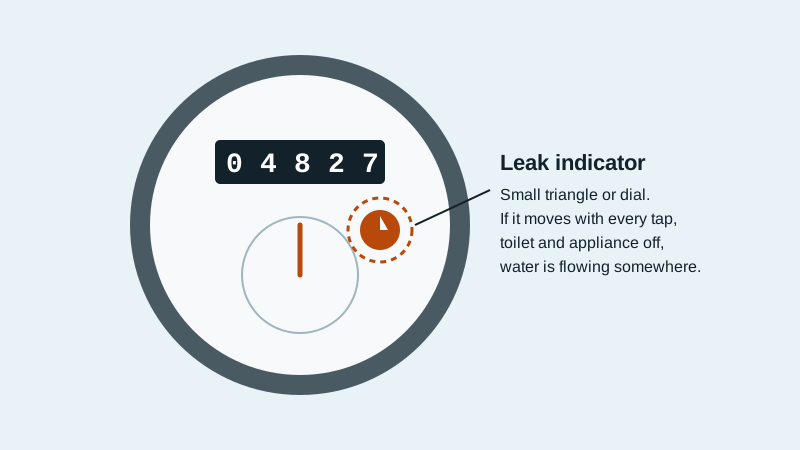
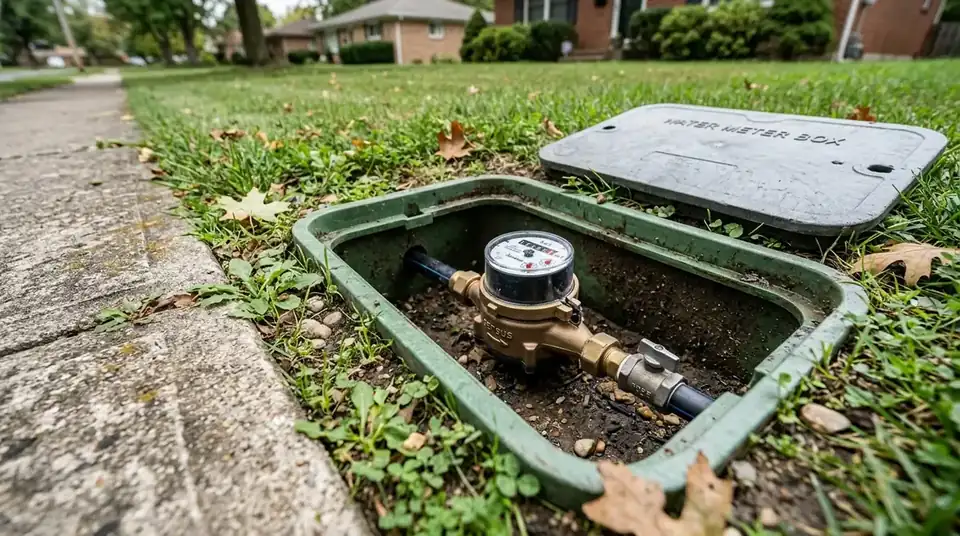
The short answer: turn off every fixture, then look at the small leak indicator on your water meter. If it spins or the reading changes over 30 to 60 minutes while nothing is running, you have a leak. Closing the house shut-off valve then tells you whether the leak is inside the home or on the buried service line in the yard. This water meter leak test is free, works on almost every residential meter in Lynnwood, and is the same first step most leak detection technicians take.
Before you start
- Find your meter. In Lynnwood it's usually in a covered box near the street or sidewalk. Lift the lid carefully; spiders and standing water are common.
- Find your house shut-off valve, usually where the line enters the house or near the water heater.
- Have your phone ready to photograph the meter readings.
How to read a water meter
Most homes in the Lynnwood area have one of two meter types:
- Analog (dial) meters show a row of numbers like a car odometer, a large sweep hand that makes one full turn for each cubic foot or ten gallons, and a small low-flow indicator. The low-flow indicator is the part that matters most for finding a slow leak.
- Digital meters show the reading on a small screen. Many display a flow rate or a faucet or leak symbol when water is moving. Some need light on the solar panel or a tap on the screen before they wake up.
Your bill shows usage in either gallons or hundreds of cubic feet (CCF). One CCF is about 748 gallons, so even a small change on the meter can add up over a two-month billing cycle.
Step 1: Stop all water use
Turn off every faucet and shower. Make sure the dishwasher, washing machine, ice maker, water softener and irrigation system aren't running. Don't flush toilets during the test.
Step 2: Watch the leak indicator
Look at the meter face. If the small leak indicator (often a red or black triangle, star or small dial) is turning, water is flowing past the meter right now. If it's perfectly still, move on to step 3 to catch slower leaks.
Step 3: Take a timed reading
Photograph the full meter reading, including the sweep hand. Wait at least 30 minutes, ideally an hour, without using any water. Photograph it again. Any change means water is leaving the system somewhere.
Step 4: Inside or outside?
Close the main shut-off valve at the house and watch the meter again.
| Result with house valve closed | What it suggests | Next step |
|---|---|---|
| Meter stops | The leak is inside the house | Check toilets, then see hidden leak detection |
| Meter keeps moving | The leak is on the line between the meter and the house, or the valve doesn't fully close | See water line leak detection |
Step 5: Rule out toilets
Toilets are the most common indoor leak. Add a few drops of food coloring to each tank. Wait 15 minutes without flushing. If color appears in the bowl, the flapper is leaking. A flapper is an inexpensive part and an easy fix for most people. Our guide to a toilet running constantly explains how much water a bad flapper wastes.
Step 6: Check the usual suspects
If toilets pass the dye test but the meter is still moving with the house valve open, check these next:
- Water heater: the drain valve, the temperature and pressure relief line, and the inlet and outlet connections.
- Water softener or filter systems that may be stuck in a backwash or regeneration cycle.
- Outdoor hose bibs and any hose left connected with a leaky nozzle.
- Irrigation and sprinkler valves, which can weep even when the controller is off.
- Refrigerator ice maker and dishwasher supply lines.
How much meter movement means a leak?
| What you see with all water off | What it likely means |
|---|---|
| Indicator perfectly still, reading unchanged after an hour | No measurable leak at the moment |
| Indicator creeping slowly, small change after an hour | A slow leak, often a toilet flapper, dripping faucet or weeping valve |
| Indicator spinning steadily, sweep hand moving | A significant leak, such as a broken pipe, a slab leak or a main water line leak |
| Indicator moves, then stops, then moves again | Something is cycling, such as a toilet refilling, a softener or a sprinkler zone |
Any steady movement is worth tracking down. The EPA's WaterSense Fix a Leak Week pages note that household leaks waste a surprising amount of water each year, and most of it comes from a few common fixtures.
What the test can't tell you
A meter test tells you whether water is escaping and roughly which side of the house valve. It can't pinpoint where. If toilets and fixtures check out and the meter still moves, that's when professional leak detection in Lynnwood helps. A technician uses acoustic listening equipment, thermal imaging and moisture meters to narrow the search before anyone opens a wall or digs up the yard. If the meter only moves when the house valve is open and nothing visible is wet, a hidden leak inside a wall, under a floor or in a concrete slab is possible.
Signs that often go with a moving meter
- A water bill that jumped without a change in household use.
- The sound of running water when every fixture is off.
- Warm spots on a tile or concrete floor.
- Low water pressure, damp spots in the lawn or a soggy area along the path of the service line.
- Musty smells, stains or bubbling paint on walls or ceilings.
Frequently asked questions
Is it normal for my water meter to move when no water is running?
No. If every fixture and appliance is off and the leak indicator still moves, water is flowing somewhere past the meter. Check toilets, irrigation and appliances first, then close the house shut-off valve to see whether the leak is inside or outside.
How long should I wait to check for a slow leak?
Watch the leak indicator for a few minutes first. For slow leaks, take a reading, wait 30 to 60 minutes without using water, then read it again. Doing it overnight, before anyone showers in the morning, catches very small leaks.
Who is responsible for a leak between the meter and the house?
In most cases the property owner is responsible for the service line on the house side of the meter, and the water utility is responsible for the meter and the street side. Confirm with your utility, since rules vary.
Can a water meter test find a slab leak?
It can show that a leak exists and that it is on the house side of the shut-off valve, but it can't say where. If you suspect a leak under a concrete floor, a technician can pinpoint it with acoustic and thermal equipment.
Will a leak show up on my water bill?
Usually, yes. A sudden jump in usage is often the first sign. If the leak is on your side of the meter and you repair it, your utility may offer a leak adjustment. See our Lynnwood water leak adjustment guide.
Call your water utility. Leaks at the meter or on the street side are usually the utility's responsibility. See our service area page for which utility serves your address.
Think you have a hidden leak?
Call and describe the symptoms. You will get straight answers about what testing involves and what it may cost before anyone visits.