Toilet Running Constantly? How Much Water It Wastes and What to Do
A toilet that keeps running, hisses, or refills on its own is one of the most common reasons a Lynnwood water bill jumps. The good news: it is usually one of three parts in the tank, and you can check them in about fifteen minutes.
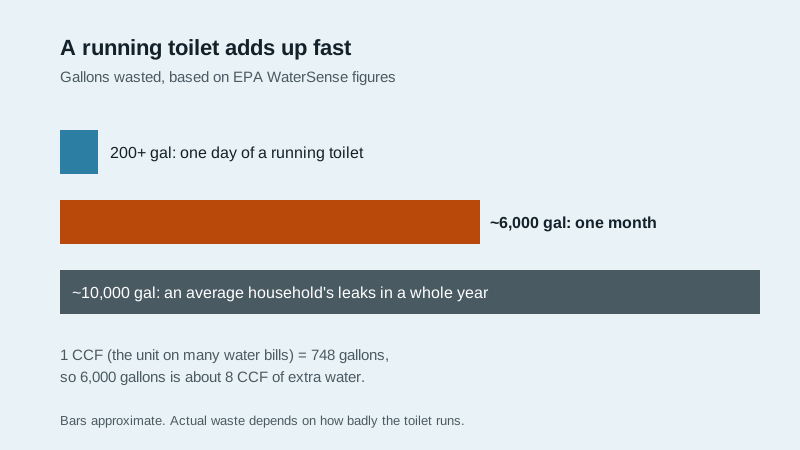
- A toilet that runs nonstop can waste 200 gallons of water or more every day, according to the EPA's WaterSense program. Over a month that can be thousands of gallons on your bill.
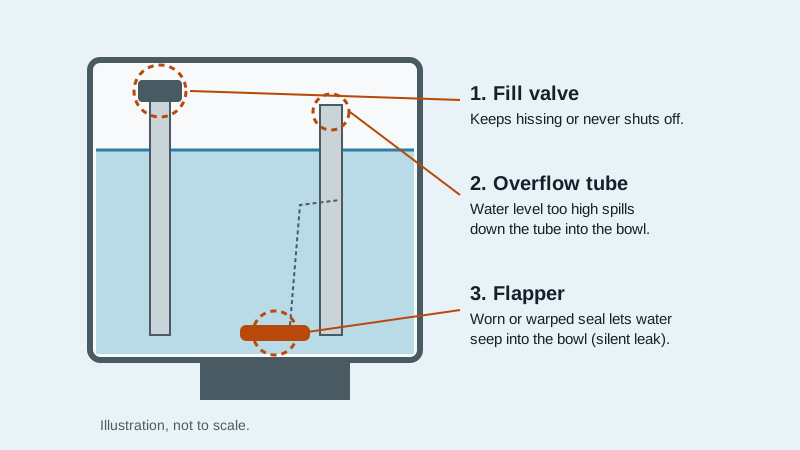
- Almost every running toilet comes down to one of three things inside the tank: a worn flapper, a water level set above the overflow tube, or a fill valve that won't shut off.
- A few drops of food coloring in the tank will tell you if water is leaking into the bowl, even when you can't hear it.
- If every toilet passes the test and your water meter still moves with everything off, the leak is somewhere else, often hidden in a wall, under the floor or in the yard.
How much water does a running toilet waste?
More than most people expect. The EPA's WaterSense program says a running toilet "could be wasting 200 gallons of water or more every day." That's about 6,000 gallons over a 30-day billing period. The EPA also estimates that an average household's leaks add up to nearly 10,000 gallons a year, and that about nine percent of homes have leaks wasting 50 gallons or more per day.
Many water bills measure use in CCF (100 cubic feet). One CCF is 748 gallons, so a toilet running all month could add roughly 8 CCF of extra water, plus any sewer charges that are based on water use. A slow, silent leak wastes less, but it can go on for months because nobody notices it.
Signs your toilet is leaking
- You hear water running or hissing long after a flush.
- The toilet refills by itself for a few seconds every so often, with no one using it (sometimes called a "phantom flush").
- You have to jiggle the handle to make it stop.
- There are faint ripples in the bowl or a steady trickle down the inside of the bowl.
- Your water bill went up but your habits didn't change.
A toilet can also leak without any of these signs. That's why the dye test is worth doing on every toilet in the house, not just the one that sounds wrong.
Step 1: Do the dye test
- Take the lid off the tank and set it somewhere safe. Tank lids are heavy and break easily.
- Add a few drops of food coloring (or a dye tablet from your utility) to the water in the tank. Don't flush.
- Wait at least 10 minutes. The EPA's guidance is that if any color shows up in the bowl after 10 minutes, you have a leak.
- Flush afterward so the dye doesn't stain the bowl.
Color in the bowl means water is getting past the flapper or over the overflow tube. No color, but the toilet still runs or hisses? Look at the fill valve and the water level next.
Step 2: Find which part is the problem
| What you see | Likely cause | Common fix |
|---|---|---|
| Dye seeps into the bowl; water level in the tank is below the top of the overflow tube | Worn, warped or dirty flapper, or a rough flush valve seat | Clean the seat or replace the flapper with one that fits your toilet model |
| Water is spilling into the top of the overflow tube | Water level set too high, or fill valve not shutting off | Lower the float so the water stops about an inch below the top of the tube; replace the fill valve if it still runs |
| Flapper doesn't close all the way after a flush | Chain too short, tangled or caught under the flapper | Adjust the chain so it has a little slack |
| Constant hissing, tank never quite fills | Worn fill valve seal or debris in the valve | Flush out or replace the fill valve |
| Water on the floor around the base or under the tank | Not a running toilet; could be the supply line, tank bolts, wax ring or a leak from another fixture | Shut off the toilet's supply valve and see our bathroom leak detection page |
Step 3: Fix it or call a plumber
Flappers and fill valves are inexpensive, widely sold parts, and replacing them is a common do-it-yourself job. Turn off the small valve on the wall behind the toilet, flush to empty the tank, then swap the part following the package instructions. Take the old flapper with you to the store, since sizes and styles vary. The EPA recommends checking the flapper periodically and replacing it at least every five years.
If you aren't comfortable working on it, or the shut-off valve behind the toilet is stuck or leaking, a licensed plumber can handle the repair. Leak Detection Lynnwood finds leaks; we don't do repairs, so a running toilet you've already pinpointed is a job for a plumber, not for us.
When it isn't the toilet
Sometimes every toilet passes the dye test and the bill is still high. Before you assume the utility made a mistake, do a meter check: turn off all water in the house and watch the small leak indicator on your meter. Our step-by-step guide on how to check your water meter for a leak walks through it, including how to tell if the leak is inside the house or on the buried line in the yard.
If the meter keeps moving with all toilets and fixtures off, water is going somewhere you can't see. Common culprits in Lynnwood homes include a pipe leaking inside a wall, a slab leak under the floor, or a break in the underground service line. That's when hidden water leak detection makes sense. A technician uses tools like acoustic listening, thermal imaging and pressure testing to locate the leak so a plumber can repair it with as little opening of walls and floors as possible. Toilet supply lines and drain connections can also leak inside a ceiling below an upstairs bathroom; see wall and ceiling leak detection if you've noticed a stain.
Once the leak is repaired, some utilities may credit part of a high bill. Our guide to Lynnwood water leak adjustments explains how that usually works. A running toilet may or may not qualify, so check with your utility.
FAQ
Can a running toilet really double my water bill?
It can add a lot. At 200 gallons a day, a toilet running all month wastes about 6,000 gallons. How much that changes your bill depends on your normal use and your utility's rates, but it's often very noticeable.
Is a toilet that refills every few minutes leaking?
Yes. If the tank refills on its own with no one using it, water is slowly escaping into the bowl, usually past the flapper. Do the dye test to confirm.
Do I need leak detection for a running toilet?
Usually not. A running toilet is easy to find with the dye test. Leak detection is for leaks you can't see, like when your toilets pass the test but the water meter still shows water flowing.
Should I shut off the water to a running toilet?
If you can't fix it right away, turning off the supply valve behind the toilet stops the waste. Turn it back on when you need to flush, or until the part is replaced.
Next step
Check every toilet with the dye test today. It costs almost nothing and catches the most common indoor leak. If the toilets are fine but your meter or bill says water is still disappearing, call Leak Detection Lynnwood at (425) 276-0836 and ask about scheduling a leak detection visit, including same-day availability. You can also learn more about our leak detection services in Lynnwood.
Source for water-waste figures: EPA WaterSense, Fix a Leak Week.
Think you have a hidden leak?
Call and describe the symptoms. You will get straight answers about what testing involves and what it may cost before anyone visits.