How to Find Your Main Water Shut-Off Valve
When a pipe bursts or a supply hose lets go, every minute the water runs adds to the damage. Knowing where your main water shut-off valve is, and how to close it, is the one plumbing skill every homeowner should have before they need it.
- Your main water shut-off valve is almost always where the water line enters the house. In Lynnwood homes, look first in the crawl space, then the garage near the water heater, a utility or laundry closet, and the outside wall facing the street.
- Follow the line from the water meter box near the street toward the house. The valve is usually within a few feet of where the pipe comes through the foundation.
- To turn the water off to the house, turn a round wheel handle clockwise until it stops, or turn a lever handle a quarter turn so it sits across the pipe.
- Find it and test it now, on a calm day, then label it so anyone in the house can find it fast.
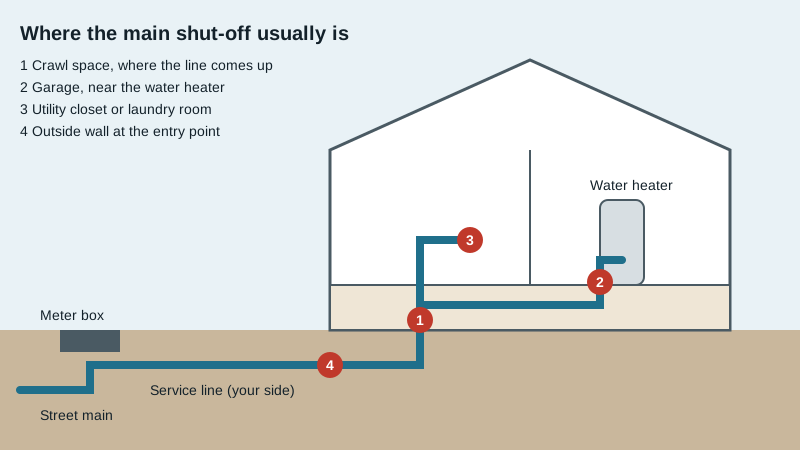
Where is the main water shut-off valve in a house?
Water flows from the city main through your meter, then underground to the house through the service line. The main shut-off is the first valve on that line inside or at the house, so find where the pipe comes in and you'll find the valve.
Here are the usual water shut-off valve locations in homes around Lynnwood, Edmonds, Mountlake Terrace and the rest of south Snohomish County:
- Crawl space. Many houses here are built over a crawl space. The valve is often just inside the foundation vent or access hatch on the street side, where the line rises out of the dirt. Bring a flashlight.
- Garage. In split-levels and newer homes, the line often enters through the garage wall. Check near the water heater, on the wall facing the street, or behind storage shelves.
- Utility closet or laundry room. Some homes have the valve near the washer hookups or in a closet with the water heater.
- Under the kitchen sink. In some slab-on-grade houses with no basement or crawl space, the main can end up under the kitchen sink or near the water heater.
- Outside wall or basement. Some homes have the valve on an exterior wall or in a small ground box by the foundation. In a basement, check the front wall closest to the street.
Condos and townhomes
In a condo or apartment, your unit may have its own shut-off in a closet, behind an access panel, under a sink or near the water heater. Often it controls only your unit. If you can't find one, ask your HOA or property manager where the valve for your unit is and who can close the building supply in an emergency.
How to find it step by step
- Locate the water meter. It's usually in a concrete or plastic box near the sidewalk or street, roughly in line with the house.
- Picture the straight line from the meter to the house. The service line usually runs fairly directly, so check the part of the house that faces the meter first.
- Check the inside of that wall. Look in the crawl space, garage, closet or basement on that side for a pipe coming up from the floor or through the wall.
- Look for the valve itself: a round wheel handle or a straight lever on that pipe. A pressure regulator (a bell-shaped fitting) is often installed right after it.
- Check your home inspection report. Inspectors usually note the main water shut-off location, sometimes with a photo.
Still stuck? A plumber can locate it for you, and that visit is worth it.
Gate valve vs. ball valve: which one do you have?
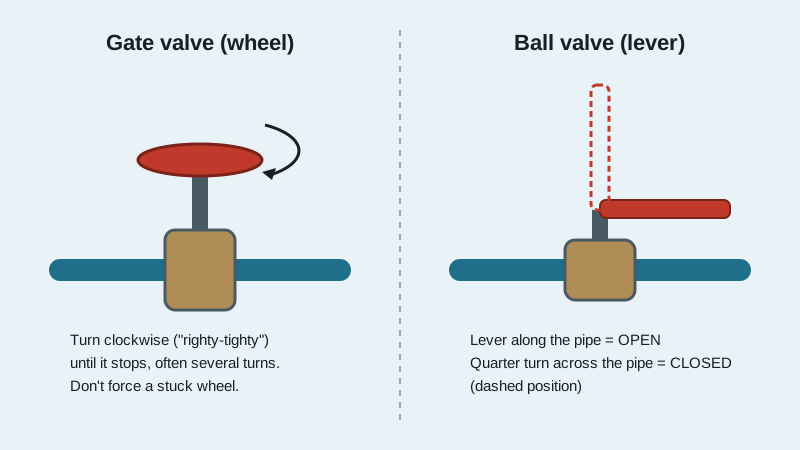
Most homes have one of two kinds of main valve:
- Gate valve (round wheel handle). Common in older homes. Turn it clockwise until it stops. That can take several full turns. Old gate valves often stick or don't seal completely, so water may still trickle after you close one.
- Ball valve (lever handle). Common in newer homes and replacements. When the lever lines up with the pipe, the water is on. A quarter turn so the lever crosses the pipe shuts it off. Ball valves are quicker and more reliable in an emergency.
How to turn off the water to your house
- Close the main valve slowly. Wheel: clockwise until snug. Lever: a quarter turn across the pipe. Don't use a long pipe wrench on a stuck wheel; you can snap the stem and create a new leak.
- Open a faucet on the lowest level and one upstairs. This confirms the water is off and drains some water out of the lines.
- Turn off the water heater's power or set a gas unit to "vacation" or "pilot" if the water will be off for a while or the leak involves the heater.
- Turn it back on slowly after the repair. Open the valve part way, let the pipes fill, then open it fully. Run each faucet until the air stops sputtering.
If you only need to stop one fixture, use its own valve instead. Toilets, sinks, the washer and the water heater usually each have a small fixture shut-off. That lets you keep water running to the rest of the house.
What about the valve in the meter box?
There is usually also a valve at the meter, sometimes called the curb stop or meter valve. It often needs a special meter key, and it's typically part of the water provider's equipment. Use the valve at the house first. If you can't close it, or the leak is between the meter and the house, call your water provider. In Lynnwood that's either the City of Lynnwood or Alderwood Water & Wastewater District, depending on your address. The City's Report a Problem page lists its Public Works after-hours emergency line.
Quick reference: which valve to use
| Situation | Valve to close | Where it usually is |
|---|---|---|
| Burst pipe or water coming through a ceiling | Main water shut-off | Crawl space, garage or utility closet |
| Toilet overflowing or tank leaking | Toilet supply valve | Wall behind the toilet, near the floor |
| Leak under the kitchen or bathroom sink | Sink angle stops | Inside the sink cabinet |
| Water heater leaking | Cold inlet valve on the heater | Pipe on top of the tank |
| Washing machine hose burst | Washer valves | Wall box behind the washer |
| Main valve stuck or leak is in the yard | Meter valve (curb stop) | Meter box; call your water provider |
Test and label your shut-off valve once a year
A valve that hasn't moved in years may not close when you need it. Once a year, close it gently, confirm a faucet stops running, then open it again. If the handle won't budge, leaks around the stem, or doesn't fully stop the water, have a plumber replace it with a ball valve. Then hang a tag on it and tell everyone in the house where it is. Washington State University Extension's earthquake preparedness guide gives the same advice: locate and label the main valve inside your home and know how to work it, since after a quake closing it keeps the water in your water heater and toilet tanks from draining away.
After you shut off the water: find the leak
Closing the main water valve stops the damage, but it doesn't tell you where the water came from. If the source isn't obvious, or you suspect a hidden leak, the main valve is also a useful test tool. With every fixture off, watch your meter's leak indicator, then close the main and watch again. If the meter still moves with the main closed, the leak is likely on the underground line in the yard. Our water meter leak test guide walks through it.
For water you can see but can't trace, our emergency leak detection service finds the source so the repair opens as little wall or floor as possible. For stains or dripping overhead, see wall and ceiling leak detection. If the meter points to the yard, water line leak detection traces the underground service line. Found the valve in a damp crawl space? See crawl space leak detection.
Leak Detection Lynnwood locates leaks; we don't repair them. Once we've pinpointed the spot, the plumber of your choice makes the fix. If you ever smell gas near the water heater or utility area, leave the house right away and call 911 or your gas utility from outside.
FAQ
Where is the water shut-off valve in my house?
Usually where the water line enters the house: the crawl space, the garage near the water heater, a utility or laundry closet, or an outside wall facing the street. Follow the line from your water meter toward the house to find it.
How do I turn off the water to my house in an emergency?
Go to the main shut-off and turn a wheel handle clockwise until it stops, or turn a lever a quarter turn so it crosses the pipe. Then open a faucet to confirm the water is off.
What if my main water shut-off valve is stuck?
Don't force it with a long wrench, since that can break the valve. Close the individual fixture valve if the leak is at one fixture. Otherwise, call your water provider about the meter valve and have a plumber replace the stuck main.
Which way do you turn a water shut-off valve to close it?
Wheel handles turn clockwise to close. Lever handles are closed when they sit across the pipe and open when they line up with it.
Can I turn off the water at the meter myself?
The meter valve usually needs a special key and is generally the water provider's equipment. Use the valve at the house first and contact your provider if you need the meter valve closed.
Next step
Take ten minutes this week to find your main water shut-off valve, test it and label it. If you've already had to shut the water off and can't tell where the leak is, call Leak Detection Lynnwood at (425) 276-0836 and ask about same-day availability, or learn more about our leak detection services in Lynnwood.
Think you have a hidden leak?
Call and describe the symptoms. You will get straight answers about what testing involves and what it may cost before anyone visits.