Leak Under the Kitchen Sink or Dishwasher: Signs and Where It Starts
The cabinet under a kitchen sink holds more water connections than almost any other spot in the house. When something there drips, it often goes unnoticed until the cabinet floor swells or the flooring next to the dishwasher starts to lift.
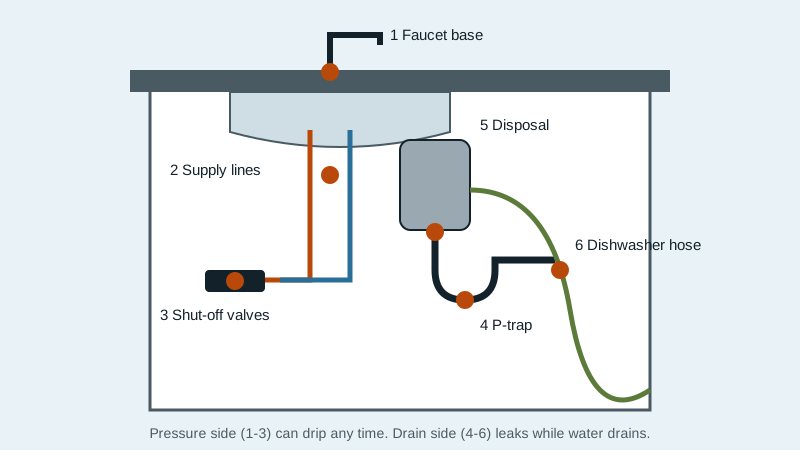
- A leak under the kitchen sink usually starts at one of six places: the faucet base, the hot or cold supply lines, the shut-off valves, the drain and P-trap, the garbage disposal, or the dishwasher hoses that run through the cabinet.
- Water under the dishwasher usually comes from the door gasket, drain hose or water inlet valve.
- Dry everything, put down a paper towel, then run one thing at a time. The first wet spot tells you where to look.
- If every fitting stays dry but water keeps showing up, the leak may be inside the wall.
Warning signs of a kitchen sink or dishwasher leak
Most kitchen leaks are slow and leave clues that are easy to brush off:
- A soft, swollen or stained cabinet floor. Particleboard bottoms soak up water and puff up or peel at the edges.
- A musty smell when you open the sink cabinet, even if nothing looks wet.
- Water under the dishwasher or along the toe kick after a cycle.
- Flooring that lifts, cups or darkens next to the dishwasher or in front of the sink.
- Dried water lines, mineral crust or rust on pipes, valves or the disposal.
- A higher water bill with no change in how your household uses water.
Where a leak under the kitchen sink usually starts
Faucet base and sprayer
Water can seep around the base of the faucet or the pull-out sprayer and run down through the mounting holes. Check the underside of the sink right after someone uses the faucet; a worn seal or loose mounting nut is the usual cause.
Supply lines and shut-off valves
The flexible lines that feed the faucet are always under pressure, so a drip there never stops, even when no one uses the sink. Check both ends of each line and the valve stems.
Drain, P-trap and garbage disposal
The drain side only leaks when water is going down it, so these leaks show up during dishes and stop afterward. Slip nuts on the P-trap can loosen over time. A garbage disposal can leak at the sink flange on top, at the dishwasher hose connection on the side, or from the bottom of the unit.
Dishwasher hoses in the sink cabinet
Your dishwasher's drain hose usually runs up into the sink cabinet and connects to the disposal or a drain tailpiece, and its water supply often comes from a valve under the sink. Both connections can drip inside the cabinet, so a sink cabinet leak is sometimes really a dishwasher leak.
Why the dishwasher is leaking underneath
Water in front of or under the dishwasher usually comes from one of these:
- Door gasket. A torn, flattened or dirty rubber seal lets water out the front, usually at the bottom corners.
- Too much or the wrong detergent. Hand dish soap in a dishwasher makes heavy suds that push out past the door.
- Drain hose. A loose clamp, a crack or a clog behind the unit can leak out of sight.
- Water inlet valve or supply line. These sit behind the lower kick panel and can drip whether or not the dishwasher is running.
- Pump or tub seal. Worn internal seals can leak water from the bottom of the machine during a cycle.
Before calling for an appliance repair, confirm the water really comes from the dishwasher and not from a sink pipe or the wall behind it.
A simple paper towel test to find the drip
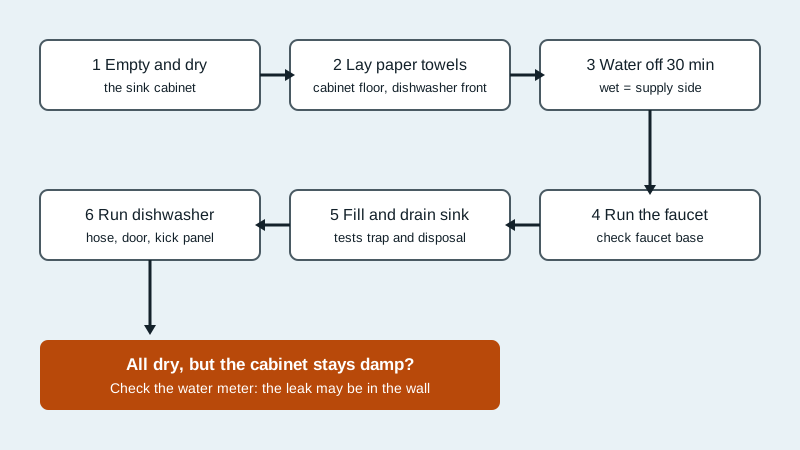
- Empty the cabinet and wipe every pipe and valve dry.
- Lay dry paper towels on the cabinet floor and under the dishwasher front if you can reach.
- Wait 30 minutes without using any water. A wet spot now points to the supply lines, valves, or the dishwasher inlet, which are always under pressure.
- Run the faucet for a minute and check the faucet base and the underside of the sink.
- Fill the sink, then pull the stopper. A full sink tests the drain and disposal better than a running tap.
- Run a dishwasher cycle and check the drain hose connection under the sink and the floor in front of the machine.
If none of these steps makes a wet spot but the cabinet keeps getting damp, use your water meter. Our step-by-step water meter leak test walks you through it.
What the signs usually point to
| What you notice | Likely source | Typical next step |
|---|---|---|
| Cabinet floor wet even when no one has used water | Supply line, shut-off valve or dishwasher supply | Tighten or replace the line or valve |
| Drips only while the sink drains | P-trap, drain tailpiece or disposal flange | Snug slip nuts or reseal the drain |
| Water dripping from the bottom of the disposal | Worn garbage disposal | Replace the disposal |
| Water in front of the dishwasher after a cycle | Door gasket, suds or leveling | Clean or replace the gasket, check detergent |
| Water under the dishwasher, kick panel area wet | Inlet valve, supply line or drain hose | Appliance or plumbing repair |
| Swollen cabinet, musty smell, all fittings stay dry | Pipe inside the wall or floor | Professional leak detection |
When the leak is behind the cabinet
Kitchen pipes come out of the wall or up through the floor at the back of the sink cabinet. A pinhole or failed joint just behind that wall can soak the cabinet back, the subfloor or the room below. In Lynnwood homes with a crawl space, a hidden kitchen leak often drips onto the crawl space ground, where no one sees it for months.
Clues include a wet cabinet back panel, stains spreading from the wall rather than a fitting, swollen baseboard near the sink, or a damp ceiling below a second-floor kitchen. Opening drywall to look is guesswork. Our hidden water leak detection service uses moisture meters, thermal imaging and acoustic listening to find where the water starts, so the repair opens only the spot that needs it. If stains are already showing on walls or a ceiling, see our wall and ceiling leak detection page, and if you suspect water is reaching the crawl space, crawl space leak detection can confirm it.
Why small kitchen leaks are worth fixing now
A drip may look harmless, but it adds up. The EPA's WaterSense program says one drip per second can waste more than 3,000 gallons a year, and that the average household's leaks can waste more than 9,300 gallons a year (EPA WaterSense Fix a Leak Week). Under a sink, the bigger cost is often a warped cabinet, subfloor or flooring. Finding the source early keeps the repair small.
Detection versus repair
Leak Detection Lynnwood finds leaks; we don't repair plumbing or appliances. If the test shows you the drip, call a plumber or appliance technician. Call us when the source isn't clear, the damage keeps spreading, or your meter shows water moving with everything off.
FAQ
Why is there water under my kitchen sink but no visible leak?
It may be a slow drip that dries between uses, water seeping down from the faucet base, a dishwasher hose connection, or a pipe leaking inside the wall behind the cabinet.
Can a dishwasher leak cause water under the sink?
Yes. The dishwasher drain hose and often its supply line connect inside the sink cabinet, so a loose clamp or worn hose there can look like a sink leak.
Why is my dishwasher leaking from the bottom?
Common causes are a worn door gasket, too many suds, a loose drain hose, a faulty water inlet valve or a worn pump seal. Water that appears with the dishwasher off points to the supply line or inlet valve.
Is a leak under the kitchen sink an emergency?
A steady stream or spray is. Close the shut-off valves under the sink, or the main valve if those don't stop it. A slow drip is not an emergency, but get it found and fixed soon to avoid cabinet and floor damage.
Next step
Empty the cabinet, dry everything and run the six-step test. If you can't find the source, or the water seems to come from behind the cabinet, call Leak Detection Lynnwood at (425) 276-0836 and ask about same-day availability. You can also read more about our leak detection services in Lynnwood.
Think you have a hidden leak?
Call and describe the symptoms. You will get straight answers about what testing involves and what it may cost before anyone visits.