Water Heater Relief Valve Leaking? What the Drip Means
A puddle at the end of the pipe running down the side of your water heater is easy to mistake for a tank leak. Most of the time it is the relief valve doing its job, and the real question is why it has to.
- When a water heater relief valve is leaking, it is usually releasing water because pressure or temperature in the tank got too high. The three common causes are high house water pressure, thermal expansion in a closed system, and a worn or dirty valve.
- Check your water pressure with an inexpensive gauge on a hose bib. Over 80 psi points to the pressure reducing valve. Pressure that climbs while the heater runs points to thermal expansion.
- Never cap, plug or shorten the discharge pipe. If hot water is flowing out rather than dripping, turn the heater off and call a plumber.
What the relief valve does
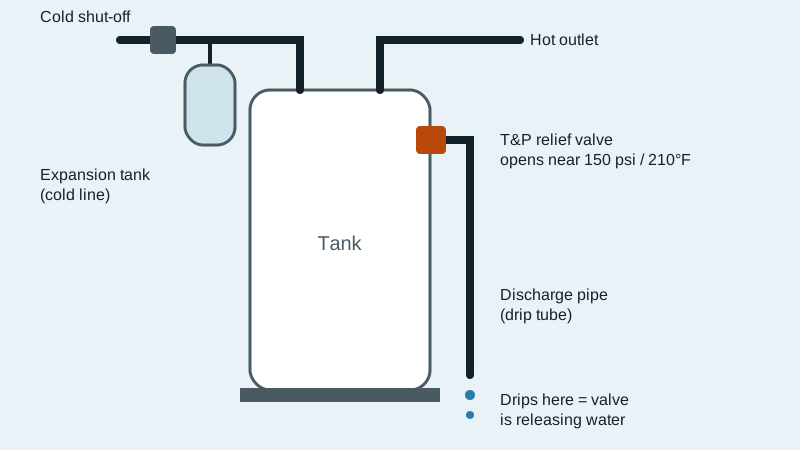
Every tank water heater has a temperature and pressure relief valve, usually called the T&P valve. It is a brass valve with a small lever, threaded into the top or upper side of the tank. A pipe runs from it down the side of the heater and ends a few inches above the floor or a drain pan. People call that pipe the discharge pipe, discharge line, drip tube or overflow pipe. They all mean the same thing.
The valve is a safety device. Residential T&P valves are generally made to open at about 150 psi or 210°F. If the tank ever reaches either limit, the valve opens and dumps water through the pipe so the tank can't build dangerous pressure. So when you see water coming out of that pipe, the valve is telling you something. Treat the drip as a symptom, not the problem.
Why a water heater relief valve leaks
Here are the causes plumbers check, roughly in order of how often they turn out to be the answer.
1. High water pressure in the house
Plumbing codes generally cap home water pressure at 80 psi, and most plumbers like to see 50 to 60 psi. Many homes have a pressure reducing valve (PRV), a bell-shaped fitting on the main line near where water enters the house, often in the crawl space or garage in Lynnwood houses. PRVs wear out. When one fails, house pressure can creep up toward street pressure, and the relief valve starts weeping. High pressure also shows up as banging pipes, a toilet fill valve that hisses, or faucets that spurt when you open them.
2. Thermal expansion
Water expands when it heats. In an open system, that extra volume simply pushes back out toward the street. Many homes now have a closed system: a check valve, backflow device or PRV stops water from flowing backward. Then each heating cycle has nowhere to put the expanded water, so pressure spikes and the T&P valve releases a little. The classic sign is a drip that shows up while the burner or elements are running, often overnight, and stops after. The usual fix is a thermal expansion tank on the cold line, sized for the heater and set to your house pressure.
3. A worn, dirty or recently tested valve
Mineral scale or sediment can lodge under the valve seat so it never quite closes. This often happens right after someone lifts the test lever. A valve that drips steadily at normal pressure and normal temperature has likely worn out and needs replacing.
4. Water that is too hot
A thermostat set very high, or a failed thermostat or gas control, can push the water toward the valve's temperature limit. This is the cause to take most seriously. Water released this way is very hot, and there may be a lot of it.
How to check what's causing the drip
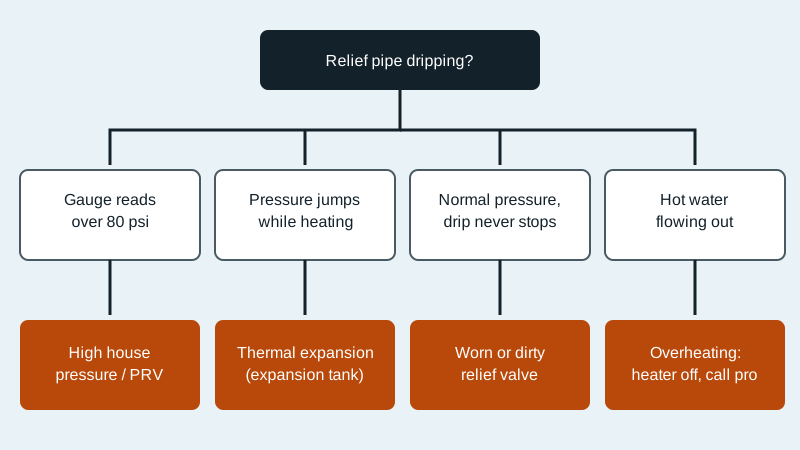
- Look at how much water there is. A few drops or a damp spot under the pipe is a slow release. A steady stream of hot water is an overheating problem. Turn the heater off at the breaker or set the gas control to "pilot," and call a plumber.
- Confirm it's really the valve. Dry the top of the tank and the pipe with a paper towel. If water runs down the outside of the pipe from a fitting above, the leak is at a connection, not the valve. Our guide to a water heater leaking from the bottom covers those other sources.
- Test your water pressure. Screw a water pressure gauge onto an outside hose bib or the laundry faucet, with no water running in the house. A gauge with a "lazy" or maximum needle is best because it records the peak, and pressure is often highest at night.
- Watch the gauge during a heating cycle. Run some hot water so the heater fires, then turn everything off and watch. If pressure climbs steadily while the heater runs, thermal expansion is the likely cause.
- Note when the drip happens. Overnight or during heating points to expansion. All the time at normal pressure points to the valve itself.
Quick guide: what the drip is telling you
| What you see | Likely cause | Usual fix (by a plumber) |
|---|---|---|
| Gauge reads over 80 psi | Failed or missing pressure reducing valve | Replace or adjust the PRV |
| Drip only while the heater runs or overnight | Thermal expansion in a closed system | Add or recharge an expansion tank |
| Steady drip at normal pressure | Worn or scaled T&P valve | Replace the valve |
| Hot water flowing, not dripping | Overheating: thermostat or gas control | Heater off now, then service |
| Water running down the pipe from above | Leaking fitting on top of the tank | Tighten or replace the fitting |
What not to do
- Don't cap or plug the discharge pipe. That disables the one device keeping the tank from over-pressurizing.
- Don't shorten or remove the pipe. It's there to aim scalding water at the floor, not at someone's legs.
- Don't keep lifting the test lever to "reset" a dripping valve. That can stir up scale and make it worse.
- Don't crank the thermostat up to make up for a heater that seems weak. The U.S. Consumer Product Safety Commission recommends setting water heaters to 120°F to lower the risk of scald burns; see its tap water scald safety guide.
If you ever smell gas near the heater, don't touch any switches. Leave the house and call 911 or your gas utility from outside.
When the drip isn't from the relief valve
Sometimes a homeowner blames the T&P valve when the water is really coming from somewhere else: a pinhole in a nearby copper line, a supply line in the wall behind the heater, or the floor under a garage heater where a line runs through the slab. If you've dried everything, the relief pipe stays dry, and water still shows up, the leak is hidden. That's when water heater leak detection or hidden water leak detection saves time and drywall. Detection tells you exactly where the water is coming from, so the plumber fixes the right thing the first time.
Leak Detection Lynnwood finds leaks; we don't repair valves or replace water heaters. Once the source is confirmed, the plumber of your choice handles the fix.
FAQ
Is it normal for a water heater relief valve to drip?
No. An occasional drop may happen, but a valve that drips regularly is reacting to high pressure, thermal expansion or a worn seat. It's a sign to check your water pressure, not something to ignore.
Why is my water heater discharge pipe dripping at night?
House pressure is often highest at night when few people use water, and the heater may cycle while the system is closed. Both point to high pressure or thermal expansion rather than a bad valve.
Will an expansion tank stop the relief valve from leaking?
If thermal expansion is the cause, a correctly sized and charged expansion tank usually stops the drip. It won't fix a failed pressure reducing valve or a worn T&P valve.
Can I still use my water heater if the T&P valve is leaking?
A slow drip at normal temperature is usually not an emergency, but get it checked soon. If hot water is pouring out or the tank is making loud rumbling noises, turn the heater off and call a plumber.
What water pressure is too high for a house?
Most plumbing codes treat 80 psi as the upper limit. Many plumbers aim for 50 to 60 psi. A simple hose bib gauge lets you check yours in a minute.
Next step
Put a pressure gauge on a hose bib this week and note the reading before you call anyone. If the relief pipe is dry and you still have water near the heater, call Leak Detection Lynnwood at (425) 276-0836 and ask about same-day availability, or see all of our leak detection services in Lynnwood.
Think you have a hidden leak?
Call and describe the symptoms. You will get straight answers about what testing involves and what it may cost before anyone visits.