Water Heater Leaking From the Bottom: Causes and What to Do
A puddle under a tank water heater is worrying, but it doesn't always mean the tank is done. Water collects at the bottom no matter where it starts, so the first job is to find out where it is really coming from.
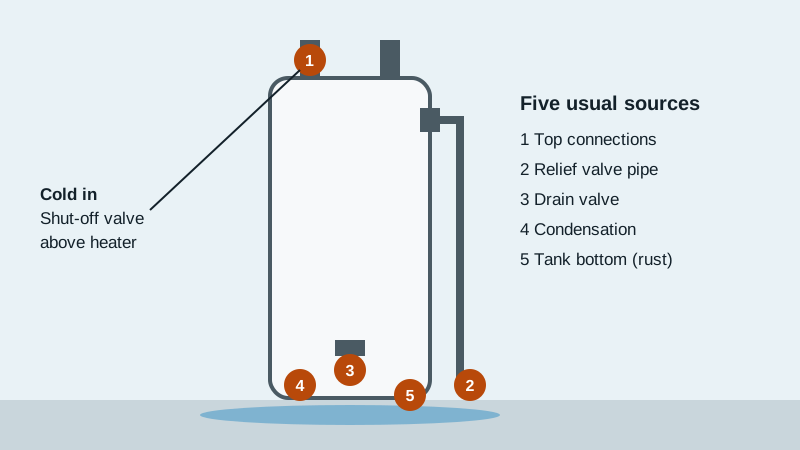
- Water at the base of a water heater usually comes from one of five places: the drain valve, the temperature and pressure (T&P) relief valve and its discharge pipe, a connection on top that drips down the side, condensation, or the tank itself.
- Drain valve, relief valve and connection leaks are often repairable. Water seeping from rust on the tank body usually means the tank needs replacing.
- If water is spreading, turn off the cold water valve above the heater and turn off its power or gas supply before you do anything else.
- If you smell gas near a gas water heater, leave the house right away and call 911 or your gas utility from outside.
First, make it safe
A slow drip can wait a few minutes while you look. A steady flow can't. If the floor is getting wet faster than a towel can keep up:
- Shut off the cold water supply. Look for the valve on the cold pipe going into the top of the heater. Turn a round handle clockwise, or turn a lever so it sits across the pipe.
- Cut the energy. For an electric heater, switch off its breaker. For a gas heater, turn the gas control to "Off" or "Pilot" following the label on the unit.
- Move things away and dry the area so you can see where new water appears.
Be careful: water from a heater can be hot enough to scald. Don't put your hands under a valve that is spraying or dripping until you know it isn't hot.
The five usual causes
1. The drain valve
Near the bottom of every tank is a drain valve, often a plastic or brass spigot with a hose thread. If it drips from the spout or seeps around the stem, the puddle will be right under it. Sometimes it just isn't fully closed. Try snugging the handle by hand. A capped hose thread can stop a small drip until the valve is replaced.
2. The T&P relief valve and discharge pipe
The relief valve sits near the top or side of the tank with a pipe running down toward the floor. That pipe is there to carry hot water away safely if the temperature or pressure gets too high. Water coming out of the end of that pipe looks like a bottom leak, but it isn't. A valve that releases water now and then can point to high water pressure, a thermostat set too hot, or a worn valve. Never cap, plug or remove the discharge pipe. Have a plumber check the cause.
3. Connections on top
Leaks at the cold inlet, hot outlet, gas line fittings or flexible supply lines often run down the outside of the jacket and pool at the base. Dry the top of the tank with a paper towel, then check it again in ten minutes. A wet trail on the side of the tank usually leads back to the source.
4. Condensation
Gas water heaters can drip condensation, especially when the tank is full of cold water, such as after a big run of hot water or a refill. This tends to happen in cooler months in Lynnwood garages. It usually shows up as drips under the burner area and stops once the water warms up. If it keeps going all day, it isn't condensation.
5. The tank itself
Steel tanks are lined, but over the years the inside can corrode. When it rusts through, water seeps from the bottom seam or from under the jacket, often with rust stains or a crusty buildup. There's no reliable repair for a leaking tank. It needs to be replaced, and the leak usually gets worse, not better.
Quick diagnosis table
| What you see | Likely source | Usually means |
|---|---|---|
| Drip from the spout near the bottom | Drain valve | Close it fully or replace the valve |
| Water at the end of the pipe running down the side | T&P relief valve | Have pressure, temperature and the valve checked |
| Wet trail running down the jacket from the top | Inlet, outlet or supply line fittings | Tighten or replace the fitting or line |
| Drips under the burner on a gas unit that stop as water heats | Condensation | Often normal; watch it |
| Rust, crust or seepage from the base with dry fittings and valves | Tank failure | Plan on replacement |
| Puddle near the heater, but the heater and its pipes stay dry | Something else nearby | Find the real source before replacing anything |
What to check first
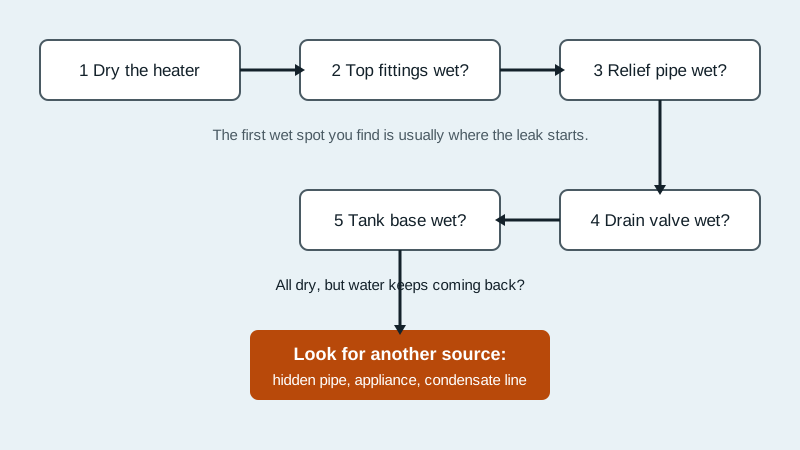
Work from the top down. Water runs downhill, so the first wet spot you find is usually the source, and the puddle at the bottom is just where it ends up. Dry the heater and the floor with towels first, then check in this order:
- Top connections. Dry the cold inlet, hot outlet and any flexible supply lines on top of the tank, then check them again in ten minutes. A wet trail down the side of the tank points back to a fitting up here.
- Relief valve discharge pipe. Look at the end of the pipe running down the side of the tank. Water there means the temperature and pressure relief valve is releasing, which points to high pressure, a thermostat set too hot, or a worn valve. Never cap or plug this pipe.
- Drain valve. Check the spigot near the bottom front. Make sure the handle is fully closed, and look for seepage around the stem. A cap on the hose thread can stop a small drip until the valve is replaced.
- Tank base and seams. Look for rust stains, crusty buildup or water seeping from the bottom seam with the valves and fittings dry. That pattern usually means the tank itself has corroded through.
- Everything around the heater. If the heater and its pipes stay dry but water keeps coming back, the source is nearby, not the heater. Check the washing machine hoses, a water softener, a furnace or air conditioner condensate line, and any pipe in the wall behind the heater.
For a gas water heater, there is one more common cause to rule out first: condensation. Burning gas makes water vapor, and on a cold tank it can drip onto the burner and look like a leak. Our guide on a gas water heater leaking from the bottom explains the overnight pilot test that tells condensation from a real tank leak.
When a leak from the bottom is an emergency
Not every puddle is an emergency, but some are. Treat it as urgent — shut off the water and the heater today — if any of these apply:
- Water is spreading. A puddle that grows, runs across the floor, or soaks into drywall, flooring or stored items needs the cold water supply shut off now, before the damage spreads.
- The tank itself is seeping. Water coming from the tank body or bottom seam, especially with rust-colored water, means the tank has corroded through. A leaking tank can fail suddenly and release its full contents.
- Hot water is involved. Water from the tank or the relief valve can be hot enough to scald. Keep away from it and do not step in standing water near electrics.
- You smell gas. Near a gas water heater, a gas smell is an emergency on its own. Leave the house right away and call 911 or your gas utility from outside. Do not touch the controls or any switches.
A slow drip from a drain valve or a connection, or a relief valve that releases water now and then, is not an emergency in the same way, but it should still be looked at soon. It wastes water and can damage the floor and framing around the heater over time. If the leak is active and you cannot find the source, our emergency leak detection service covers active leaks in Lynnwood.
What a leak detection specialist does
When the source is obvious — a dripping drain valve, a wet relief pipe, a rusted tank — you can go straight to a plumber. A leak detection visit is for the cases where the heater looks dry but water keeps showing up, or where the water could be coming from a hidden pipe. A typical water heater leak detection visit includes:
- Dry-and-watch testing. The area is dried and each connection is checked with the system pressurized, to see exactly where water reappears first.
- Relief valve and pressure checks. Discharge from the relief pipe is noted, and pressure is tested at a fixture to see whether high pressure is behind it.
- Moisture meters and thermal imaging. These trace water that has travelled along the floor or inside a wall, so a leak behind the heater is not mistaken for a heater leak.
- Acoustic listening. A pressurized pipe leak makes a sound a listening device can pick up, even through a floor or wall.
- A meter test. With all water off in the house, a moving meter leak indicator confirms water is escaping somewhere, and closing the heater's supply valve shows whether the heater is the source or a hidden line is.
You get a clear answer — drain valve, relief valve, connection, condensation, tank failure, or a hidden pipe somewhere else — and the right next step: a plumber, a water heater installer, or nobody at all. Leak detection does not include the repair or the replacement itself.
When it isn't the water heater at all
Water heaters are often in a garage, utility closet or basement, which tend to be the lowest spot nearby. A puddle there can come from a washing machine hose, a water softener, a furnace or air conditioner condensate line, or a pipe leaking inside a wall or under the floor that just drains to the low point. Replacing a heater won't fix any of those.
If the heater and its fittings stay dry after you wipe them down but water keeps coming back, check your water meter with everything off. Our guide on how to check your water meter for a leak explains how. A moving leak indicator with all fixtures off means water is escaping somewhere you can't see.
Detection versus repair
Leak Detection Lynnwood finds leaks; we don't repair them or replace water heaters. When the source is obvious, like a dripping drain valve or a rusted tank, you can go straight to a plumber. When it isn't clear, our water heater leak detection service helps confirm whether the water comes from the heater, its connections, or another line nearby. If the trail leads into a wall or floor, hidden water leak detection uses tools like thermal imaging, moisture meters and acoustic listening to pinpoint it, so the repair opens as little as possible.
The EPA's WaterSense program suggests checking your water heater regularly for leaks, aged gaskets, loose connections and corrosion, and flushing it once a year to reduce sediment. See EPA WaterSense home maintenance tips.
FAQ
Is it safe to use a water heater that's leaking from the bottom?
A small drip from the drain valve or a bit of condensation is usually not an emergency. A tank that's seeping or a leak that's growing is different. Shut off the water and power or gas, and get it looked at soon.
Can a leaking water heater tank be repaired?
A leak from the tank body itself generally can't be repaired. Valves, fittings and supply lines usually can.
Why is water coming out of the pipe on the side of my water heater?
That pipe is the relief valve discharge. Water from it can mean pressure or temperature is too high, or that the valve is worn. Don't plug it. Have a plumber check it.
Do I need leak detection for a water heater leak?
Not always. If you can see where the water starts, call a plumber. Leak detection helps when the heater looks dry but water keeps showing up, or when the source could be a hidden pipe.
What should I check first if my water heater is leaking from the bottom?
Dry the heater and the floor, then check from the top down: the connections on top, the relief valve discharge pipe, the drain valve near the bottom, and finally the tank base. The first wet spot is usually the source. If you have a gas heater, also rule out condensation with the overnight pilot test described in our gas water heater guide.
Is a water heater leaking from the bottom an emergency?
It is urgent if water is spreading across the floor, the tank itself is seeping, or the water is hot enough to scald. A slow drip from a valve or connection is not an emergency but should be looked at soon. If you smell gas near a gas water heater, leave the house and call 911 or your gas utility from outside.
How can I tell if the leak is the tank or just a valve?
If the drain valve, relief valve pipe and top connections are all dry and water still seeps from the base or bottom seam, often with rust stains, the tank has usually corroded through. A valve leak shows water at the valve itself. When the heater looks dry but water keeps returning, a water heater leak detection visit can confirm which it is.
What does a leak detection specialist do for a water heater leak?
The specialist dries the area and watches where water reappears under pressure, checks the relief valve and system pressure, and uses moisture meters, thermal imaging and acoustic listening to trace water that travelled from somewhere else. You get a named source and the right next step, such as a plumber or a water heater installer.
Can I still use hot water while the heater is leaking from the bottom?
If it is only condensation or a small drip from a valve, limited use is usually fine while you arrange a fix. If the tank itself is seeping, the puddle is growing, or water is hot enough to scald, shut off the cold water supply and the power or gas, and do not use the heater until it has been looked at.
Next step
Dry the heater, check it from the top down, and note where the first water shows up. If you can't find the source or you suspect a hidden pipe, call Leak Detection Lynnwood at (425) 276-0836 and ask about same-day availability. You can also learn more about our leak detection services in Lynnwood.
Think you have a hidden leak?
Call and describe the symptoms. You will get straight answers about what testing involves and what it may cost before anyone visits.