Frozen or Burst Pipe? What to Do First
Lynnwood winters are usually mild, so a hard freeze can catch a house off guard. Here is how to tell a frozen pipe from a burst pipe, what to do in the first ten minutes, and how to check for a hidden leak after the thaw.
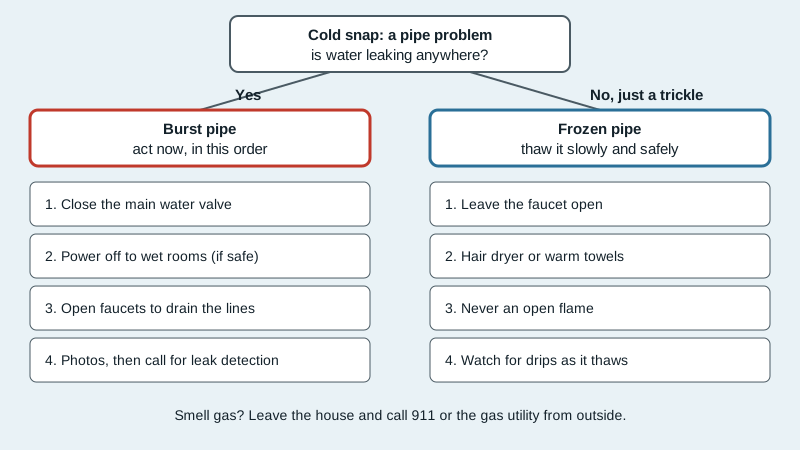
- If water is spraying, dripping or spreading, you have a burst pipe. Close the main water shut-off valve first, switch off power to any wet room if you can do it safely, then open a faucet to drain the lines.
- If a faucet gives only a trickle and nothing is leaking, the pipe is probably frozen. Leave the faucet open and warm the pipe slowly with a hair dryer or warm towels. Never use an open flame.
- A pipe that froze can split without leaking until it thaws. After any frozen or burst pipe, watch the walls and ceilings and run a water meter test to make sure there is no hidden leak.
Frozen pipe or burst pipe: how to tell
Both problems usually show up on the first cold morning, and the first clue is often the same: you turn on a faucet and almost nothing comes out. What happens next tells you which one you have.
| What you see | Likely frozen pipe | Likely burst pipe |
|---|---|---|
| Faucet flow | A trickle or nothing from one or two faucets | Weak flow across the house, or normal flow plus a leak |
| Water where it shouldn't be | None | Dripping, spraying, a wet ceiling, water under a door or in the crawl space |
| Sounds | Usually quiet | Hissing or running water with everything off |
| Pipe itself | Frost on the pipe, very cold to the touch | A visible split, bulge or a fitting pushed apart |
| Water meter | Barely moving | Leak indicator spinning with all fixtures off |
Water expands as it freezes. That pressure is what splits a pipe, and the split often sits a little away from the ice plug. This is why many burst pipes only start leaking once the weather warms up and the ice melts.
What to do when a pipe bursts
A burst pipe is a real emergency leak. Work through these steps in order. The first one matters most.
- Shut off the main water valve. Most Lynnwood homes have an indoor shut-off where the water line comes into the house: in the crawl space, the garage, a utility room or near the water heater. Turn a round handle clockwise until it stops, or turn a lever a quarter turn so it sits across the pipe. If you have never found yours, our guide on how to find your main water shut-off valve shows where to look. It is worth finding before the next freeze.
- Make it safe. If water is near outlets, light fixtures or appliances, switch off those breakers, but only if you can reach the panel without standing in water. Keep people and pets away from a sagging, wet ceiling.
- Drain the lines. Open a faucet on the lowest level of the house to let the water left in the pipes run out. If the leak is on a hot line, turn the water heater to its vacation or pilot setting, following the maker's instructions.
- Limit the damage. Move furniture and boxes, put buckets under drips, and soak up standing water. If a ceiling is bulging, don't poke it while you stand underneath it.
- Take photos. Shoot the wet areas, the pipe if you can see it, and the date. Notes like "found 7:10 a.m., valve closed 7:15" help later with the repair and any insurance claim.
- Call for help. Describe where the water appears, and whether it stopped when you closed the valve. If you can't see where the water comes from, call Leak Detection Lynnwood at (425) 276-0836 and ask about same-day availability. Our emergency leak detection page explains how an active leak is tracked down.
If you smell gas near a gas water heater or furnace, leave the house now and call 911 or your gas utility from outside. Don't flip switches on the way out.
What if the valve won't close or the leak is at the meter?
If the house valve is stuck or the leak is between the meter and the house, the water has to be shut off at the meter box near the street. The City of Lynnwood asks customers not to turn the meter valve themselves. Its Public Works staff will turn it, or show you how to use it in an emergency, during business hours. After hours, the City's Report a Problem page lists an emergency number. Some Lynnwood-area addresses get water from Alderwood Water & Wastewater District instead, so check whose name is on your water bill.
How to thaw a frozen pipe safely
If nothing is leaking and you get only a trickle, a pipe is probably frozen, often in the crawl space, along an outside wall or in the garage. Thawing it slowly gives you the best chance of avoiding a burst.
- Open the faucet the pipe feeds. Running water helps melt the ice and relieves pressure as it thaws.
- Find the cold spot. Follow the pipe back from the faucet. Frost on the pipe or a section that is much colder than the rest is a good sign of the ice plug.
- Warm it gently. Use a hair dryer, a heating pad, warm towels or a space heater kept a safe distance from anything that can burn. Start near the faucet and work back toward the frozen section.
- Never use an open flame. A torch, a propane heater or a charcoal grill can start a fire inside a wall or crawl space, and sudden heat can crack the pipe.
- Keep going until full pressure returns, then check every other faucet. If one line froze, others may have too.
Stop and call a plumber if you can't reach the frozen section, if the pipe is inside a finished wall, or if it won't thaw. If you see water as it thaws, close the main valve right away, because the pipe has split.
Where pipes freeze in Lynnwood homes
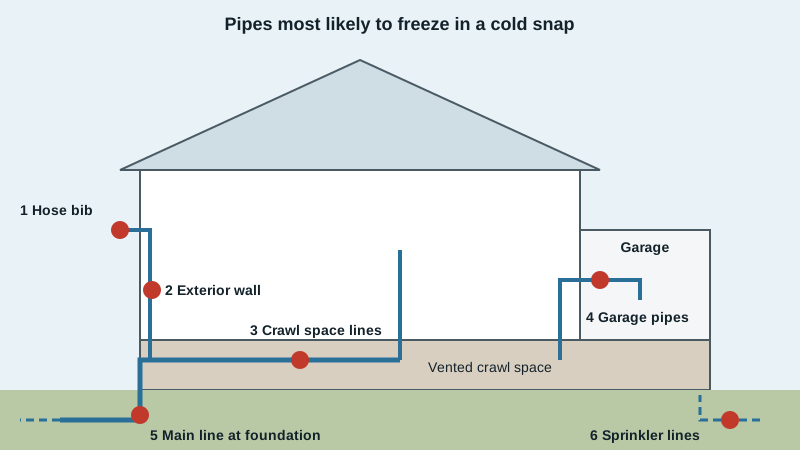
Many Lynnwood houses sit over vented crawl spaces, so cold air can reach the supply lines from below. The usual trouble spots are:
- Outdoor hose bibs, especially if a hose was left attached. A frost-free spigot can still split inside the wall if a hose traps water in it.
- Pipes in the crawl space, where insulation has fallen, a vent cover is missing, or the pipe runs close to a foundation vent.
- Pipes along exterior walls, such as a kitchen sink on an outside wall.
- The garage, including water heater lines and laundry hookups.
- The main line where it comes through the foundation.
- Sprinkler lines and backflow devices that weren't drained in the fall. Our irrigation leak detection page covers leaks in those lines.
Before a forecast freeze: disconnect hoses, close any indoor valve that feeds an outdoor faucet and open the faucet outside to drain it, open sink cabinets on outside walls, keep the heat on day and night, and let a faucet drip on a line that has frozen before. If you'll be away, leave the heat on rather than turning it off.
After the thaw: check for a hidden leak
The most expensive freeze damage is often the leak nobody sees: a small split inside a wall, under a floor or in the crawl space that drips for weeks. Once the pipes have thawed and the water is back on, check for these signs:
- New stains, bubbling paint or soft spots on walls and ceilings
- A damp, musty smell, or wet insulation in the crawl space
- The sound of running water when everything is off
- Water pressure that is weaker than before the freeze
- A higher water bill with no change in how you use water
The simplest test is the meter. Turn off every fixture and watch the leak indicator on your water meter for a few minutes. If it moves, water is escaping somewhere. Our guide to checking your water meter for a leak walks through it, including how to tell a leak in the house from a leak in the buried line outside.
How a hidden leak is found after a freeze
If the meter says water is leaking but you can't see where, pipe leak detection narrows it down without opening walls at random. A typical visit includes:
- Pressure testing to confirm which line, hot or cold, is losing water
- Acoustic listening to hear the leak through walls, floors or soil
- Thermal imaging to spot wet areas, especially on hot water lines
- Checking the crawl space, hose bib lines and the main service line
- Marking the spot, with notes and photos for the repair and any insurance claim
Leak Detection Lynnwood finds leaks; we don't repair them. Once the spot is marked, the plumber of your choice can fix just that section, which usually means a smaller hole and a smaller bill. Find out more about our leak detection in Lynnwood.
FAQ
What should I do first when a pipe bursts?
Close the main water shut-off valve. Then switch off power to wet rooms if it is safe, open a low faucet to drain the lines, and take photos before you clean up.
How do I know if a pipe is frozen or burst?
A frozen pipe gives a trickle or no water and no leak. A burst pipe leaks: drips, spray, a wet ceiling or a meter that keeps moving with everything off. A frozen pipe can turn into a burst pipe as it thaws.
Can a frozen pipe burst after it thaws?
Yes. The split often happens while the pipe is frozen, but the leak only starts when the ice melts. Watch the area closely as it thaws and keep the main valve within reach.
Should I turn off the water heater if a pipe bursts?
If the leak is on a hot water line, or the main valve will be off for a while, set the heater to vacation or pilot following the maker's instructions. That keeps it from heating with no water coming in.
Is a burst pipe an emergency leak?
Yes. A broken supply line can release a lot of water fast. Shut off the water first, then call. If water stops when the valve closes, you have time to find the leak properly.
How can I tell if there is a hidden leak after a freeze?
Turn off all water and watch the meter's leak indicator. If it moves, there is a leak. Stains, a musty smell or low pressure after a cold snap are other clues.
Next step
Find your main water shut-off valve today, before the next cold snap, and make sure everyone at home knows where it is. If a pipe has burst or the meter keeps moving after a freeze, call Leak Detection Lynnwood at (425) 276-0836 and ask about same-day availability.
Think you have a hidden leak?
Call and describe the symptoms. You will get straight answers about what testing involves and what it may cost before anyone visits.