Water Pressure Suddenly Low? How to Find the Cause
When the shower turns weak or the kitchen tap barely fills a pot, it's easy to assume the city is working on the lines. Sometimes that's true. Other times the drop is coming from inside your own plumbing, and a hidden leak is one of the causes worth ruling out early.
- If your water pressure is suddenly low, first find out whether it's one faucet, only the hot water, or the whole house. That one check narrows the cause fast.
- One weak faucet usually means a clogged aerator or a problem in that fixture. Weak hot water only points to the water heater.
- A sudden drop in water pressure across the whole house usually comes from the water provider, a partly closed main valve, a failing pressure regulator, or a leak in the supply line.
- Run a quick water meter leak test with every fixture off. If the meter still moves, water is escaping somewhere.
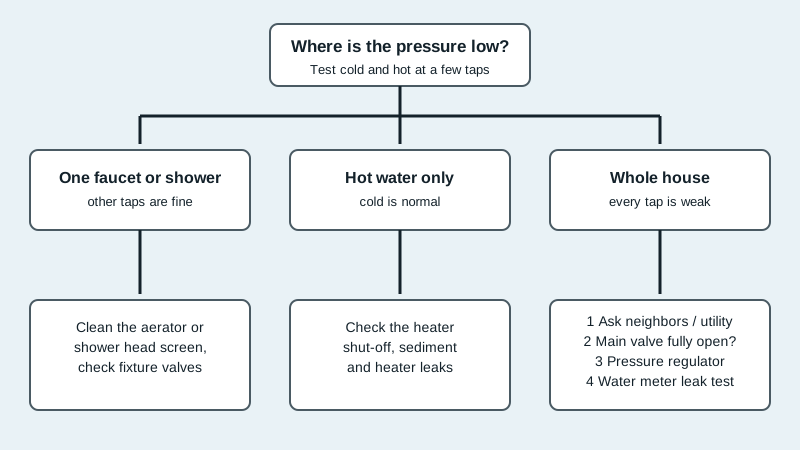
Step 1: Is it one faucet or the whole house?
Open the cold side, then the hot side, at the kitchen sink, a bathroom sink, a shower and an outdoor hose bib. The pattern tells you more than any single tap:
- Low water pressure at one faucet or shower only. The problem is almost always at that fixture.
- Low pressure on hot water only. Cold is normal everywhere, so the water heater or its piping is the likely spot.
- Low water pressure in the whole house. Every tap is weak, hot and cold. The cause sits upstream: at the street, the meter, the main line or the valves where water enters the house.
Common causes of low pressure at one fixture
A single weak faucet is the easiest case. Unscrew the faucet aerator (the small screen at the tip of the spout) and look for grit or mineral crust. Rinse and scrub it, then screw it back on. Shower heads have a similar screen. If the flow is still weak, check that the small shut-off valves under the sink are fully open; they sometimes get bumped when the cabinet is crowded. A worn cartridge inside the faucet can also restrict flow, and that's a job for a plumber.
Why only the hot water has low pressure
If cold water is strong but hot water is weak at every tap, look at the water heater. Make sure the shut-off valve on the cold inlet above the tank is fully open. Sediment in an older tank, or a clogged inlet filter on a tankless unit, can also restrict flow. Also look around the base of the tank and the connections on top for water. Our guide to a water heater leaking from the bottom covers the usual leak spots, and our water heater leak detection page explains how we confirm a leak around the tank or its lines.
Causes of a sudden drop in water pressure in the whole house
Work on the water main or a utility issue
Before anything else, ask a neighbor whether their pressure is low too. In Lynnwood, water comes from either the City of Lynnwood or Alderwood Water & Wastewater District, depending on your address. If several homes on your street are affected, check your provider's website or call them about main breaks, hydrant flushing or planned work. After service returns, loosened sediment can clog aerators, so clean them afterward.
A main shut-off valve that isn't fully open
If anyone recently turned off the water for a repair, the main valve may not have been opened all the way again. Find your main shut-off, usually where the line enters the house in the garage, crawl space or a utility closet, and make sure it's fully open. An old gate valve can also fail inside and stay partly closed.
A failing pressure reducing valve
Many homes have a pressure reducing valve (PRV), a bell-shaped fitting on the main line near where it enters the house. It lowers high street pressure to a safe level for your fixtures. These valves wear out over time. The City of Kirkland's pressure reducing valve FAQ notes that PRVs commonly last 10 to 15 years, that the homeowner is usually responsible for them, and that a noticeable drop in pressure, sudden swings, or banging pipes are common signs of failure. Leave the adjustment screw alone; a plumber should test and adjust or rebuild the valve.
A leak in the water line or inside the house
This is the cause people miss. Water escaping from a broken pipe never reaches your faucets, so a large leak shows up as weak pressure everywhere. The leak can be on the underground service line between the meter and the house, inside a wall, under the floor or in a slab. Low pressure plus a higher bill, a soggy patch of lawn, running-water sounds or warm floor spots is a strong hint.
Old or corroded pipes
In older homes with galvanized steel pipes, rust slowly narrows the pipe. That usually causes a gradual loss of pressure, but loosened scale can suddenly block a valve, and corroded pipe also leaks more easily.
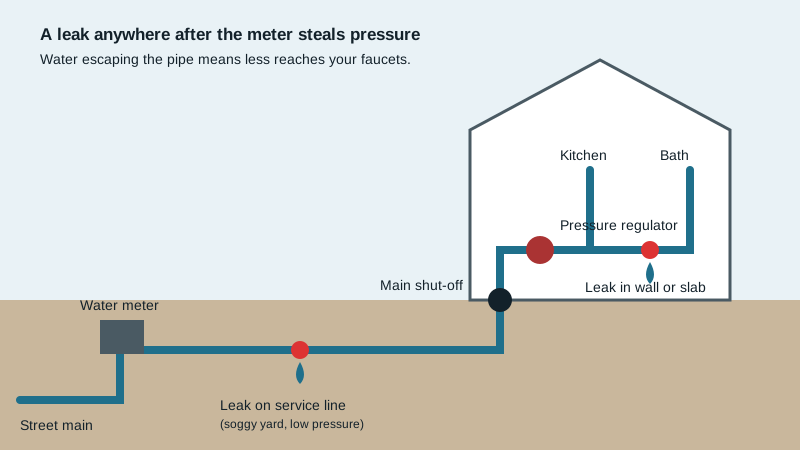
How to check for a leak when water pressure is suddenly low
Use your water meter. It's the simplest way to know whether low pressure is caused by water escaping somewhere:
- Turn off every fixture and appliance that uses water, including the ice maker and irrigation.
- Find your meter, usually in a box near the street or sidewalk, and lift the lid.
- Watch the leak indicator (a small triangle or dial) for a few minutes. If it moves, water is flowing.
- Write down the reading, wait 30 to 60 minutes without using any water, and read it again.
- Close the main shut-off at the house and watch the meter again. If it still moves, the leak is likely on the underground line between the meter and the house. If it stops, the leak is likely inside the home.
Our full guide on how to check your water meter for leaks walks through each step and shows how to read the dials.
What the signs usually point to
| What you notice | Likely cause | Next step |
|---|---|---|
| One faucet or shower is weak | Clogged aerator, shower head screen or cartridge | Clean the screen, check the fixture valves |
| Only hot water is weak | Water heater valve, sediment or heater leak | Check the heater inlet valve and look for water |
| Whole street has low pressure | Main break, flushing or planned utility work | Contact your water provider |
| Pressure dropped after plumbing work | Main valve not fully open, debris in lines | Open the main fully, clean aerators |
| Pressure swings, banging pipes | Failing pressure reducing valve | Have a plumber test the PRV |
| Low pressure plus soggy yard or higher bill | Water line leak | Meter test, then leak detection |
| Meter moves with all water off, stops when the main is closed | Leak inside walls, floors or slab | Professional leak detection |
When to call for leak detection
If the meter test shows water moving while nothing is on, the next job is to find where. Digging or opening walls to look is costly guesswork. Our water line leak detection service traces the underground service line with acoustic listening and line tracing to pinpoint the spot. For leaks inside the home, hidden water leak detection uses moisture meters, thermal imaging and pressure testing so the repair opens only the area that needs it. If you see warm floor spots or hear water under a slab floor, see our slab leak detection page.
Leak Detection Lynnwood finds leaks; we don't repair them. Once the leak is located, a plumber of your choice makes the repair. If you smell gas at any point while checking your water heater or utility area, leave the house and call 911 or your gas utility from outside.
FAQ
Why is my water pressure suddenly low in my whole house?
The most common reasons are utility work or a main break, a main shut-off valve that isn't fully open, a failing pressure reducing valve, or a leak in the supply line.
Can a water leak cause low water pressure?
Yes. Water that escapes through a broken pipe doesn't reach your faucets, so a large leak on the service line or inside the house can lower pressure everywhere. A meter that moves with all water off confirms a leak.
What is normal water pressure for a house?
Many homes run roughly 40 to 60 psi. A gauge on an outdoor hose bib will tell you yours. Very high pressure, above about 80 psi, can damage fixtures and water heaters, which is why many homes have a pressure regulator.
How do I know if my pressure reducing valve is bad?
Common signs include a sudden drop in pressure, pressure that swings up and down, banging pipes, or pressure that stays too high.
Why is the water pressure low in only one bathroom?
Check the aerators and shower head screens first. If every fixture in that bathroom is weak, the valves or the branch pipe feeding it may be partly blocked, or there may be a leak on that branch.
Next step
Do the faucet check, ask a neighbor, and test your water meter. If the meter shows a leak or you can't find the cause, call Leak Detection Lynnwood at (425) 276-0836 and ask about same-day availability. You can also learn more about our leak detection services in Lynnwood.
Think you have a hidden leak?
Call and describe the symptoms. You will get straight answers about what testing involves and what it may cost before anyone visits.