Pinhole Leaks in Copper Pipes: Signs, Causes and What to Do
A pinhole leak in a copper pipe is tiny, but it rarely stays harmless. It can spray inside a wall for weeks before a stain shows. Here is how to spot one, what causes copper to pit, what to do right now, and how to decide between fixing one section and replacing the line.
- A pinhole leak in a copper pipe is a tiny hole, usually caused by corrosion that pits the pipe wall from the inside. It often shows up as a fine spray, a drip, blue-green spots on the pipe, or a stain on drywall along the pipe route.
- If water is spraying or near outlets, shut off the main water valve and keep away from wet wiring. A pipe clamp or repair tape is only a temporary fix.
- If you can't see the leak, do a water meter leak test. If the leak indicator moves with everything off, have the leak located before anyone opens a wall.
- One pinhole can be fixed by replacing a short section. A second or third pinhole in the same line is a sign to ask about the condition of the whole line.
Most Lynnwood homeowners find a pinhole leak by accident: a damp spot in the garage ceiling, a hiss behind the laundry wall, a mist on the copper line above the water heater, or a water bill that crept up for no clear reason. Copper has been a common material for supply lines in homes for decades, and older lines are more likely to develop small leaks. This guide explains what a copper pinhole leak is, how to find one, and what to do next.
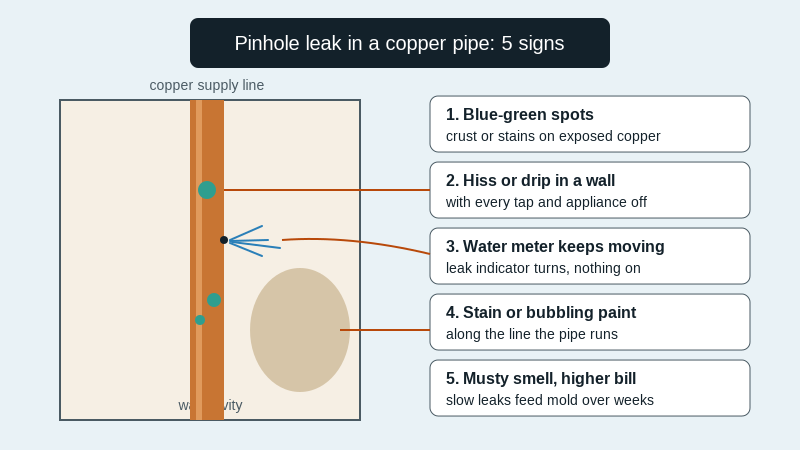
What is a pinhole leak in a copper pipe?
A pinhole leak is a very small hole in the wall of a pipe, often smaller than the head of a pin. On copper water lines it usually starts as pitting corrosion: a small spot on the inside surface corrodes faster than the copper around it, digs a pit, and eventually breaks through. Because the line is under constant water pressure, even a tiny opening can spray or drip around the clock, whether or not anyone is using water.
That is what makes them costly. A pinhole leak in a wall, ceiling or crawl space can soak insulation, framing and drywall slowly, so the damage and the mold risk build up before you notice anything.
Signs of a pinhole leak
- Blue-green or white spots on exposed copper, especially in one spot rather than evenly along the pipe.
- A hissing or dripping sound inside a wall or floor when every tap and appliance is off.
- A water meter that keeps moving when nothing is running.
- A stain, bubbling paint or soft drywall along the line where a pipe runs, often below a bathroom or near the water heater.
- A musty smell or damp insulation in the crawl space or garage ceiling.
- A higher water bill with no change in how your household uses water.
One of these signs alone doesn't prove a pinhole leak, since a running toilet or a dripping faucet can also move the meter. Two or more together, especially a moving meter plus a stain, point strongly to a pipe leak.
What causes pinholes in copper pipe?
Copper pipe corrosion has several possible causes, and often more than one is at work:
| Cause | Why it matters |
|---|---|
| Water chemistry | Water that is more acidic or aggressive can wear the protective layer inside copper. |
| High water pressure or velocity | Fast flow, especially in hot water lines and recirculation loops, can erode the pipe wall at elbows and tees. |
| Installation details | Excess flux or solder left inside joints, burrs from cutting, and tight bends can start corrosion at one spot. |
| Age and pipe wall thickness | Older lines and thinner-wall copper have less metal to lose before a hole forms. |
| Contact with other metals | Where copper meets steel (for example at a water heater) without the right fitting, the joint can corrode. |
Is Lynnwood water the problem?
It is usually not the first suspect. According to the City of Lynnwood annual water quality report, the city's water comes from Everett's Spada Lake Reservoir, and Everett adds soda ash to reduce corrosivity by raising pH and alkalinity. In the regional lead and copper tap sampling reported there, no sampled home exceeded the copper action level. That doesn't rule out water chemistry in every house, but it does mean local factors such as pressure, flow speed, workmanship and pipe age deserve a close look when a Lynnwood home keeps getting pinhole leaks. If you have questions about your water quality, the report lists the city's Water & Sewer contact.
What to do right now
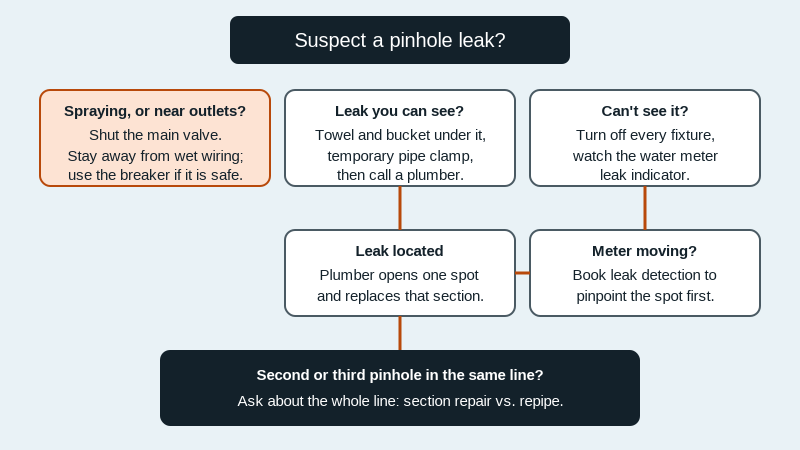
- Protect yourself first. If water is reaching outlets, light fixtures or an electrical panel, stay out of the wet area and turn off that circuit at the breaker only if you can reach it from a dry spot. If not, call an electrician.
- Shut off the water if it's spraying. Close the main shut-off valve. Our guide on how to find your main water shut-off valve shows the usual locations in Lynnwood homes.
- Catch and dry. Put a towel and bucket under a visible leak and move belongings away. Take photos for your records.
- Use a temporary fix only to buy time. A rubber-lined pipe repair clamp or self-fusing silicone repair tape can slow a visible pinhole until a plumber can replace the section. It is not a permanent repair.
- Don't disconnect grounding clamps. In some homes the electrical ground is bonded to metal water pipe. If a plumber replaces copper with plastic, ask them to make sure the bonding is kept in place.
How to find a pinhole leak you can't see
Many pinhole leaks hide inside walls, ceilings or under floors. Start with a water meter leak test:
- Turn off every faucet, shower, toilet fill, the dishwasher, the washing machine and the irrigation controller.
- Find the water meter (in Lynnwood it is usually in a box near the street or sidewalk) and look at the small leak indicator.
- If the indicator is turning, or the reading changes after an hour with no water use, water is leaving the system somewhere.
Our step-by-step guide on how to check your water meter for leaks covers the details. Next, rule out the easy ones: a running toilet, a dripping fixture, a leaking supply hose. If those are fine and the meter still moves, the leak is probably in a pipe you can't see.
That is where pipe leak detection helps. A technician isolates the hot and cold lines with valves and a pressure test, then narrows down the spot with acoustic listening, thermal imaging and moisture readings. The goal is to mark the exact location, so the plumber opens one small area instead of cutting several holes in your walls. If the leak is under a concrete floor, our guide to the signs of a slab leak explains what changes.
Water heater leaking? Check the copper lines first
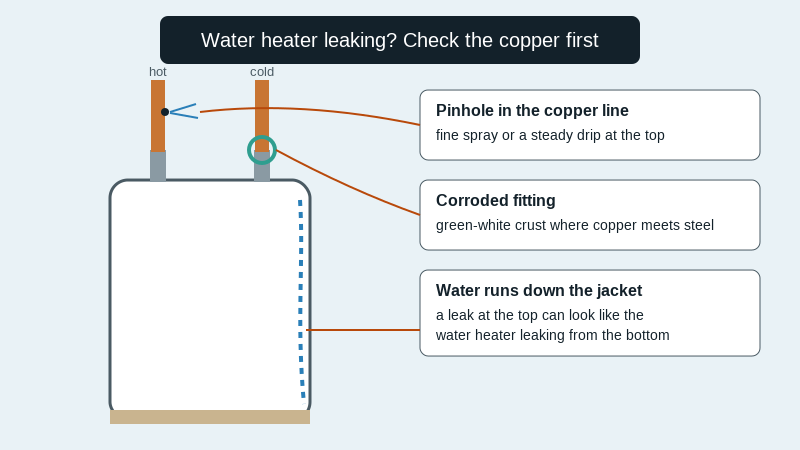
When a water heater is leaking, the tank isn't always the culprit. The copper hot and cold lines at the top of the heater are a common place for pinholes and corroded fittings, especially where copper connects to a steel nipple. Water from the top can run down the jacket and pool at the base, so a water heater leaking from the bottom sometimes starts higher up. Dry the tank, then check the top connections with a paper towel. If the top is wet and the tank is dry, the problem may be a fitting or line rather than the heater itself. Our water heater leak detection page explains how the source is confirmed.
Repair one section or repipe?
A single pinhole is usually repaired by cutting out a short piece of pipe and replacing it. The harder question is what happens next. Some practical points to discuss with your plumber:
- How many leaks so far? One pinhole may be a one-off. Repeated pinholes in the same line suggest the pipe is wearing out.
- Where are they? Leaks clustered on the hot side or near the water heater may point to flow speed, temperature or a fitting problem rather than the whole system.
- What does the removed piece look like? Ask to see the inside of the cut section. Heavy pitting along it is a warning sign.
- What is your water pressure? Plumbing codes generally call for a pressure-reducing valve when street pressure is above 80 psi. Ask the plumber to check yours with a gauge.
- Get a written quote for both options and compare them. Prices depend on the home, access and materials, so ask local plumbers rather than relying on national averages.
Leak Detection Lynnwood finds and explains leaks; the repair itself is done by a plumber of your choice. Detection first means you pay to open only the spot that needs it.
FAQ
Can a pinhole leak in a copper pipe fix itself?
Sometimes mineral deposits slow a pinhole down for a while, but the corrosion that caused it is still there. A leak that seems to stop can start again. Treat any pinhole as a leak that needs a permanent repair.
How do you temporarily fix a pinhole leak in a copper pipe?
Turn off the water, dry the pipe, and wrap the spot with self-fusing silicone repair tape or fit a rubber-lined pipe repair clamp. This only buys time until a plumber replaces the section. Don't rely on it inside a closed wall.
What does a pinhole leak in a wall sound like?
Usually a faint hiss or a steady trickle when no water is being used. It is easiest to hear at night. A water meter leak test helps confirm it before you open anything.
Are pinhole leaks more common in hot water lines?
They often show up on the hot side, around the water heater and in recirculation loops, because heat and faster flow can speed up erosion and corrosion. They can still happen on cold lines.
Does one pinhole leak mean I need to repipe the house?
Not necessarily. One pinhole is often fixed with a short section repair. If you keep getting new pinholes in the same line, ask a plumber about the condition of the whole line and compare quotes for a section repair and a repipe.
Will homeowners insurance cover a pinhole leak?
It depends on your policy. Some policies treat sudden water damage differently from long-term leaks or worn pipe. Check with your insurance company before repairs if you plan to file a claim, and take photos first.
Next step
If you see a pinhole, shut off the water and use a temporary clamp. If you suspect a hidden one, run the water meter test. If the meter moves and you can't find the source, call Leak Detection Lynnwood at (425) 276-0836 to have the leak located before any wall is opened. You can also see all our services on the Lynnwood leak detection home page.
Think you have a hidden leak?
Call and describe the symptoms. You will get straight answers about what testing involves and what it may cost before anyone visits.