New Water Heater Leaking? Condensation, Fittings or Something Else
You just paid for a new water heater, and now there is water on the floor. Before you assume the tank is bad, know this: on a just-installed heater, the leak is usually a connection, a valve or plain condensation. Here is how to tell which one, safely.
- A new water heater leaking in the first hours or days is rarely a failed tank. The usual causes are condensation while the tank is still cold, a new pipe fitting that isn't fully sealed, a drain valve left slightly open, or the relief valve releasing pressure.
- Dry everything, wait until the water in the tank is fully hot, then check again with a paper towel. Condensation fades as the tank heats up. A real leak keeps coming back at one spot.
- If the relief valve's discharge pipe drips after the replacement, high water pressure or thermal expansion is a common cause, not a bad valve.
- Don't take parts apart on a new heater. Take photos and call the installer first, so the installation and the warranty stay covered.
A new water heater leaking from the bottom, the top or the relief valve is one of the most frustrating surprises after a replacement. The good news is that most problems on a newly installed water heater come from the work around the tank, not the tank itself. New connections, a new relief valve, a drain valve that was opened during filling, and cold water sweating on the metal can all leave a puddle that looks serious. In Lynnwood homes, where heaters often sit in a garage, a utility closet or a crawl space, it is worth sorting this out quickly so a small drip doesn't soak flooring or framing.
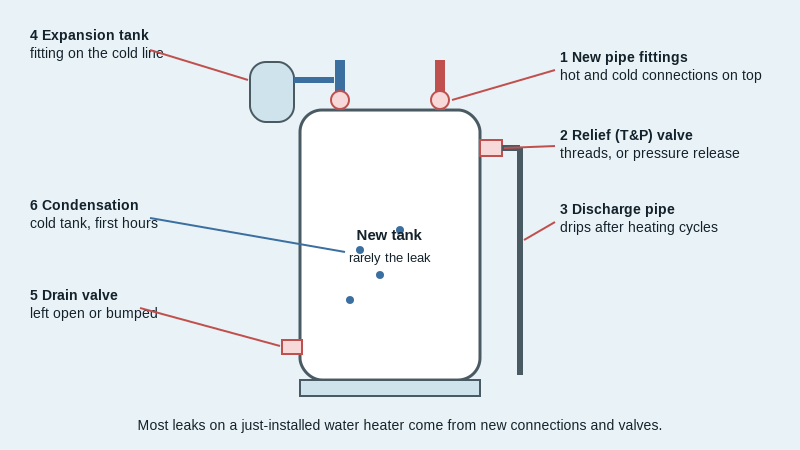
Why a new water heater leaks: the usual causes
- Condensation in the first hours. A new tank fills with cold water from the street. In a warm garage or closet, moisture in the air condenses on the cold metal and drips to the floor. On a gas unit it can drip onto the burner and hiss. This is normal for a newly installed water heater and should stop once the water is fully heated.
- New pipe connections on top. The cold water inlet and hot water outlet are new joints. A fitting that isn't tight enough, a missing washer in a flexible connector, or thread sealant that didn't seat can weep slowly and run down the side of the tank, so it shows up as a new water heater leaking from the bottom.
- Drain valve. The drain valve near the base is often opened during installation or bumped while moving the tank into place. If it isn't fully closed, or the cap is missing, it drips from the spout.
- Relief (T&P) valve threads. Some relief valves come installed from the factory and some are added on site. Either way, the threads where the valve enters the tank can weep.
- Relief valve releasing pressure. If the discharge pipe drips after every heating cycle, the valve may be doing its job. See the thermal expansion section below.
- Expansion tank or other new fittings. If the installer added an expansion tank, a shut-off valve or new piping, every new joint is a possible leak point.
- A defective tank. It is possible, but uncommon. A factory defect in the tank or a seam usually shows up as water seeping steadily from under the jacket even after every fitting and valve is dry.
Condensation or a real leak? How to tell
This is the first question to answer, because condensation needs no repair at all. Use this simple test:
- Dry everything. Wipe the tank, the pipes and the floor with towels.
- Wait until the tank is hot. A new gas or electric tank can take an hour or more to heat a full tank of cold water. Don't run lots of hot water during this time.
- Check each joint with a dry paper towel. Press it against the cold inlet, the hot outlet, the relief valve threads, the end of the discharge pipe and the drain valve spout.
- Look again in a few hours. Lay a dry paper towel on the floor under the tank and next to the discharge pipe.
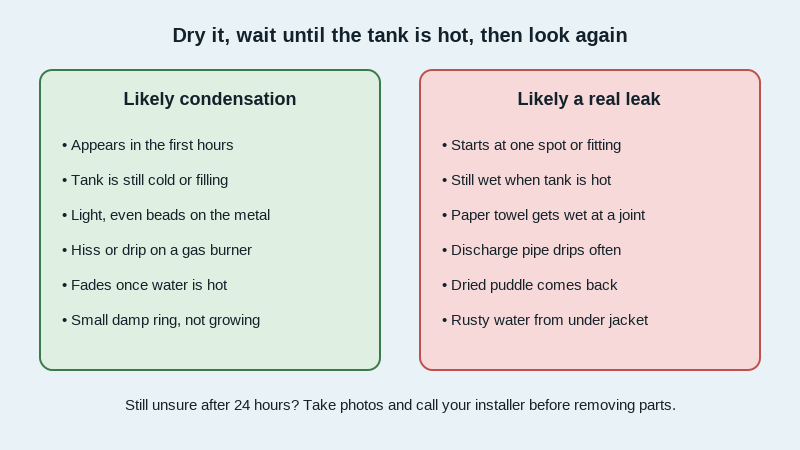
| What you see on a new water heater | Likely cause | What to do |
|---|---|---|
| Even beads of water on a cold tank, gone once hot | Condensation | Nothing; keep an eye on it |
| Wet paper towel at a top fitting | New connection not sealed | Call the installer |
| Drip from the drain valve spout | Valve not fully closed | Close it gently by hand; call if it still drips |
| Discharge pipe drips after heating | High pressure or thermal expansion | Have the pressure checked |
| Wet threads where the relief valve enters the tank | Valve fitting | Call the installer |
| Steady seep from under the jacket, all fittings dry | Possible tank defect | Turn it off, photos, warranty claim |
| Heater dry, floor still wet | Something else nearby | Meter test, then leak detection |
Water heater relief valve leaking after replacement
A very common complaint is a relief valve that never dripped on the old heater but drips on the new one. The temperature and pressure relief valve opens when the pressure or temperature inside the tank gets too high. When water heats, it expands. If your home's plumbing is a "closed system", that extra water has nowhere to go, and the relief valve becomes the escape route.
A closed system happens when there is a check valve, a backflow preventer or a pressure reducing valve on the incoming water line. A brochure on thermal expansion from the Pacific Northwest Section of the American Water Works Association, hosted by the Washington State Department of Health, explains that in these homes thermal expansion has to be controlled, usually with a thermal expansion tank on the cold water line.
So if the discharge pipe on your new heater drips after it heats, the likely causes are:
- No expansion tank, or an expansion tank that isn't charged to the right air pressure for your home
- Water pressure coming into the house that is higher than it should be
- A worn or faulty pressure reducing valve on the main line
- Less often, a defective new relief valve
Never cap, plug or remove the relief valve or its discharge pipe. It is the main safety device on the tank. For more detail, read our guide to a water heater relief valve leaking.
What to do right now
- Make it safe. For an electric heater, switch off the breaker if water is near wiring. For a gas heater, turn the control to "pilot" or "off" if the burner area is wet. If you smell gas, leave the house and call 911 or your gas utility from outside. Don't use switches or phones near the heater.
- Stop the water if it is more than a drip. Close the cold water valve on the pipe going into the top of the heater. If that doesn't work, use the main water shut-off valve.
- Protect the floor. Put down towels, move stored items, and set a pan or bucket under the drip.
- Take photos and a short video. Show where the water starts, the label on the heater, and the installation date. This helps with any warranty claim.
- Call the installer before changing anything. A leak from a new connection is part of the installation work. Removing or replacing parts yourself can make a warranty claim harder.
In Lynnwood, replacing a water heater normally goes through a city permit (a mechanical permit for gas heaters and a plumbing permit for electric ones). If your installer pulled a permit, the installation is inspected, which is another reason to let them correct the problem.
How urgent is a new water heater leak?
Condensation that fades within a day is not urgent. A slow weep at a fitting isn't an emergency either, but it shouldn't wait, because water running down inside the jacket can damage controls and insulation. Treat it as urgent if water is near electrical parts, the puddle keeps growing after you close the cold valve, water is coming from an upstairs closet over a ceiling, or the leak is coming from under the tank itself.
When the new heater isn't the problem
Sometimes a homeowner replaces an old heater because of water on the floor, and the floor is still wet afterward. That is a strong sign the water was never coming from the heater. It may be a pinhole leak in a nearby pipe, a supply line inside the wall, a washer hose, a drain, or a line under the slab.
Do a quick meter test: close the cold valve on the heater, turn off every fixture, and watch the leak indicator on your water meter for 15 minutes. Our guide on how to check your water meter for leaks shows how. If the indicator still moves, water is escaping somewhere else, and hidden water leak detection is the next step.
What a water heater leak detection visit involves
A leak detection technician doesn't install or replace water heaters. The job is to confirm where the water comes from, so you know whether to call the installer, a plumber or your warranty provider. A water heater leak detection visit can include a close inspection of the new fittings and valves, moisture meter readings on the floor and walls around the heater, thermal imaging along hot water lines, and meter and pressure tests to rule out a hidden pipe leak. For more on older tanks, see our guides to a gas water heater leaking from the bottom and an electric water heater leaking from the bottom.
FAQ
Is it normal for a new water heater to leak?
A little condensation is normal in the first hours while the tank fills with cold water, and it should fade once the water is hot. Water that keeps coming from one fitting, valve or from under the tank is not normal and should be checked by the installer.
Why is my new water heater leaking from the bottom?
Usually because water from a new pipe connection or the relief valve runs down the tank, or the drain valve near the base isn't fully closed. Condensation on a cold tank can also collect at the bottom. A defective tank is possible but uncommon.
Why is my water heater relief valve leaking after replacement?
Most often because of high water pressure or thermal expansion in a closed plumbing system, for example when there is a check valve or pressure reducing valve on the main line and no working expansion tank. Have the pressure checked before replacing the valve.
How long does condensation last on a new water heater?
Usually until the full tank of water has heated, often within an hour or a few hours. If you still see water after the tank is hot, test each joint with a dry paper towel to find a real leak.
Who should I call if my new water heater is leaking?
Call the company that installed it first, because a leak from a new connection is part of their work and may be covered. If the heater looks dry but the floor stays wet, call a leak detection company to find the hidden source.
Should I tighten the fittings myself?
It is safer not to on a new heater. Overtightening can crack a fitting or damage a connector, and changing the installer's work can complicate the warranty. Shut off the water if needed, take photos and call the installer.
Next step
Dry everything, let the tank heat fully, and do the paper towel check. If the leak is at a new fitting or valve, call your installer. If the heater is dry but the floor around it stays wet, or your meter keeps moving with everything off, call Leak Detection Lynnwood at (425) 276-0836 and ask about same-day availability. You can also learn more about our leak detection in Lynnwood and nearby Snohomish County communities.
Think you have a hidden leak?
Call and describe the symptoms. You will get straight answers about what testing involves and what it may cost before anyone visits.